


The U.S.-led initiative could move the Philippines into higher-value technology manufacturing. But the real measure of success will be whether Filipino companies, workers and institutions capture a meaningful share of what gets built.
There is an easy way to misunderstand Pax Silica.
Mention artificial intelligence, semiconductors, advanced manufacturing and trusted supply chains, and it sounds like another foreign technology investment story. Perhaps another industrial park. Perhaps another wave of data centers.
That misses the larger picture.
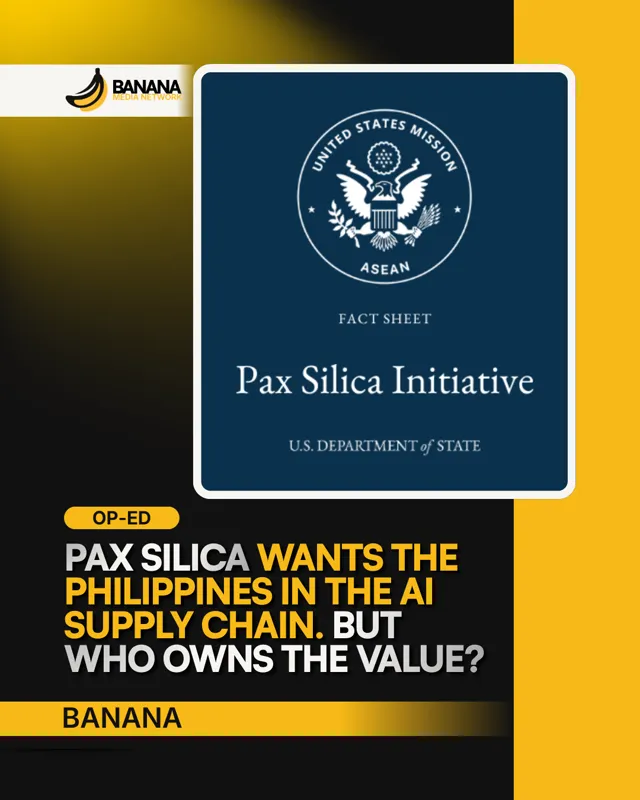
Pax Silica is an economic-security framework spanning critical minerals, processing, manufacturing, semiconductors and AI infrastructure. When the Philippines joined in April 2026, the announcement included plans for a roughly 4,000-acre industrial hub in New Clark City, Tarlac.
BCDA has repeatedly stressed that this is not simply a data-center project. The proposed development is intended to be a manufacturing-driven ecosystem, with semiconductor and advanced-technology activities at its core.
The harder question sits further upstream:
When the Philippines supplies the resources, land, electricity and workforce behind the next generation of technology, how much of the resulting value will remain here?
Pax Silica is a supply-chain play
The U.S. framework covers critical minerals, processing, infrastructure and manufacturing needed for secure semiconductor and technology supply chains.
For the Philippines, that creates a genuine opportunity.
The country has significant mineral resources, an established electronics and semiconductor sector, a large technical workforce and a strategic location in Asia. Government officials now envision the proposed Pax Silica development attracting $40 billion to $70 billion in investment and generating more than 130,000 jobs once fully developed. Those are projections, not guarantees.
The bigger opportunity is to connect what the Philippines already has to higher-value activities.
Technology Value Chain Architecture
Extracting a mineral creates one kind of economic activity. Processing it locally creates more. Manufacturing components creates more again. Developing the technology behind those components can create an entirely different level of value.
That is the leap the Philippines should be looking for.
Not simply more factories.
More capability.
The numbers
New Clark City Investment Metrics
The U.S. State Department said it intends, working with Congress, to allocate $250 million for critical-mineral, infrastructure and manufacturing investments across the initiative.
The approximate footprint of the proposed industrial hub in New Clark City.
BCDA's estimated investment potential once the proposed development is fully built out.
These figures show the scale of the ambition, but they should not be confused with money already committed to the Philippines or returns already secured for Filipinos.
The $250 million refers to a proposed fund across the Pax Silica initiative. The 4,000-acre figure describes a planned development. And the $40–70 billion represents BCDA's projected investment potential, not signed commitments.
That distinction matters because announcements create expectations long before contracts create obligations.
The Philippines isn't starting from zero
The country already participates in global semiconductor and electronics manufacturing, particularly in assembly, testing and packaging.
The next step is moving into more sophisticated activities: advanced packaging, engineering, materials processing, research, component manufacturing and eventually more technology development.
The mineral side presents the same challenge.
Nickel, copper, cobalt, chromite and other strategic materials can make the Philippines important to global supply chains. But possessing the resource is not the same as controlling the industries that ultimately use it.
The key economic question is what happens between the mine and the finished technology.
If sophisticated processing remains elsewhere, the Philippines remains primarily an upstream supplier.
If processing, manufacturing, engineering and research grow here, more expertise and economic value can accumulate here.
That difference is what Pax Silica should be judged against.
And then there is sovereignty
The most contentious episode so far has involved jurisdiction rather than AI.
In May, Philippine officials confirmed that the U.S. side had sought arrangements involving American law and diplomatic immunity for personnel at the proposed hub. BCDA President and CEO Joshua Bingcang said the Philippines did not agree to those terms and said the project would instead operate under Philippine law.
The U.S. side later disputed the characterization, with Undersecretary Jacob Helberg saying reports of a request for diplomatic immunity had taken his comments out of context. Reporting also noted that the detailed supplemental operating agreement had not yet been signed at the time.
That disagreement is worth noting precisely because it shows how much can turn on the details.
Land rights, investor protections, tax treatment, regulation, environmental obligations, dispute resolution and applicable law are not bureaucratic footnotes.
They determine who has leverage after the ribbon-cutting ceremony.
The real question is value capture
This is where the debate should move beyond the language of geopolitical alignment.
The Philippines needs foreign capital. It needs infrastructure, technology, customers and access to global markets. It cannot realistically build every layer of a sophisticated semiconductor and AI ecosystem by itself.
Foreign investors can help provide those missing pieces.
But participation in a global supply chain is not automatically the same as moving up it.
A factory can operate here while its highest-value functions remain abroad. A project can employ thousands of Filipinos without creating significant domestic ownership. Minerals can be processed locally without Philippine companies controlling the technology built around them.
None of those outcomes is predetermined.
The final agreements will matter.
What matters most is whether they create incentives and obligations for companies to build local capabilities: Filipino engineers in advanced roles, Philippine suppliers in the ecosystem, research partnerships with local institutions, domestic processing where commercially viable, and greater participation in higher-value manufacturing.
Technology transfer is particularly important.
It is easy to promise. It is harder to measure.
The public should eventually be able to see what companies are actually committing to in training, research, supplier development and technical employment.
The same applies to ownership and incentives.
If public land, infrastructure or fiscal incentives help attract major investment, the public has a legitimate interest in knowing what it receives in return.
The opportunity is real. So is the test.
Pax Silica should not be dismissed as merely another data-center announcement.
Nor does the current public record establish that it is an extraction scheme.
It is a developing industrial and economic-security framework, and the Philippine implementation is still taking shape.
That is precisely why scrutiny matters now.
The Philippines has an opportunity to use foreign investment and strategic partnerships to move further into advanced manufacturing and technology. But success will not be measured by the number of announcements, the size of the site or the amount of capital attracted.
It will be measured by what remains after the investment arrives.
More processing. More Philippine suppliers. More engineers working on high-value technologies. More research. More domestic capability. And, ultimately, more Filipino participation in ownership and value creation.
The decisive questions are simple:
What is the Philippines getting? What is it giving? And who owns what is created?
The answers will be found not in the launch speeches, but in the contracts, investment commitments, ownership structures and rules that follow.
The future may be assembled in the Philippines. The question is how much of that future Filipinos will build, own and control.