


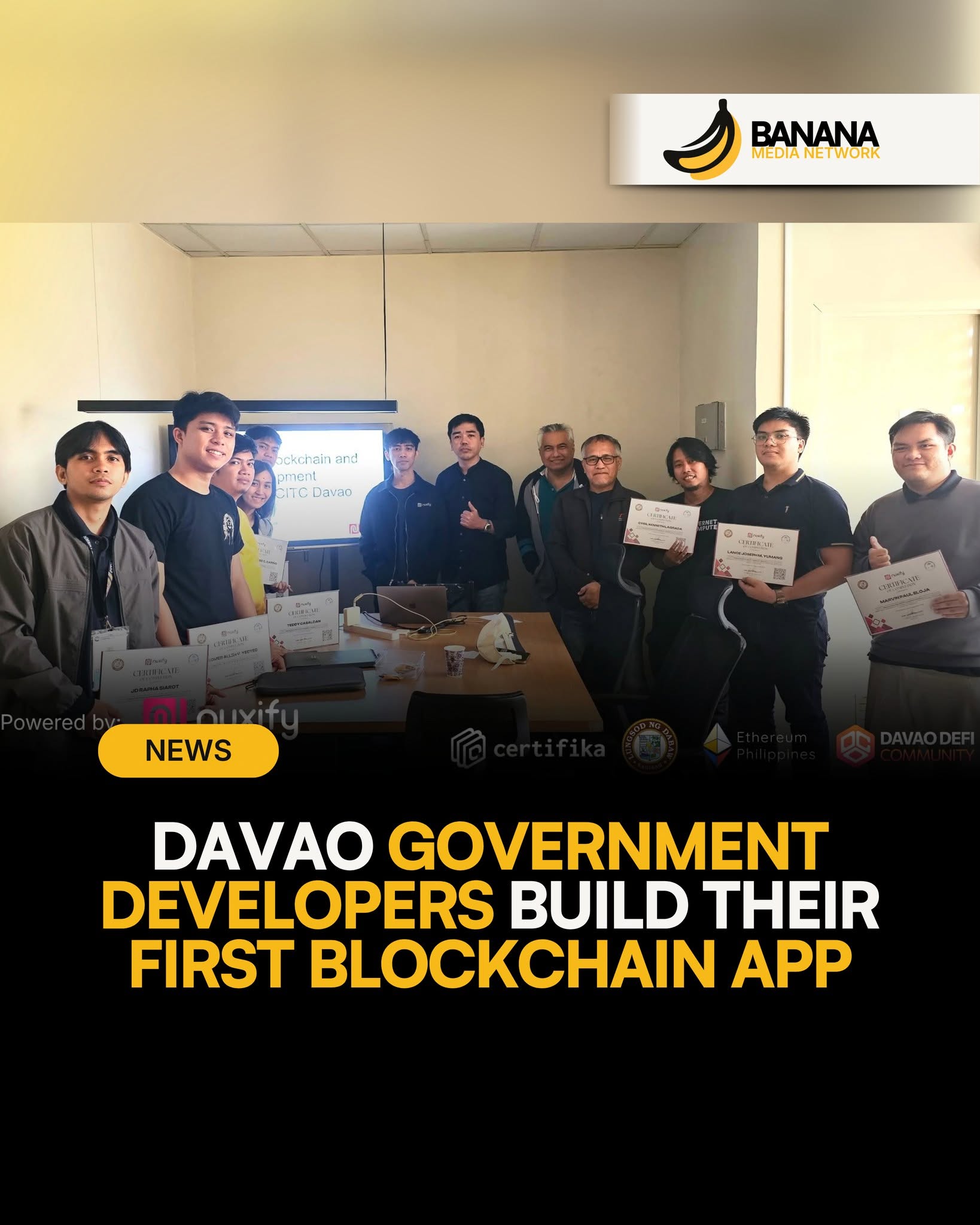
NEWS | The City Information Technology Center of Davao just wrapped up a five day blockchain training that ended with ten of its developers building and testing a working application on the Ethereum network. The training was run by Davao based blockchain company Nuxify, in partnership with ETHPH and the Davao DeFi Community, and focused specifically on writing real code, not just sitting through lectures on blockchain basics.
The five days moved from core blockchain concepts straight into actual development, covering Solidity, smart contracts, testing, and deployment. Sessions were run more like a shared workspace than a classroom, with trainers and government developers debugging code and solving problems together in real time, switching naturally between English and the local language as needed.
BMN sees this as a small but meaningful shift in how local governments approach new technology. The point was never to prove that every government service suddenly needs blockchain. The more practical outcome is that the developers themselves can now better judge where the technology might actually help, where it does not, and what it would take to turn an idea into a working application, instead of relying entirely on outside contractors to make that call for them.
That kind of technical capacity matters as government services keep becoming more digital. Before a city can seriously explore things like blockchain for public records, verification, transparency, or digital credentials, it needs people inside government who actually understand how the underlying systems work, not just people who can approve a budget for someone else to build it.
The workshop also points to a different way of adopting new technology at the local level. Instead of starting with a large procurement process or a finished system bought from an outside provider, a local government can start by developing the people who will eventually build and maintain it themselves, then let real understanding guide whatever gets built next.
There is a bigger opportunity here too, beyond government offices alone. Local tech communities have been building spaces where students, developers, and aspiring builders can learn emerging technology, meet people already working in the industry, and get practical experience that is not always available through formal channels. Government does not have to build every program on its own. Partnerships with tech communities, universities, and local industry can open up more paths for people to learn, experiment, and eventually apply those skills to real local problems.
For Davao, the application built during training is still just an early prototype, and that might be the more important point. The real result was not a finished blockchain system. It was a group of local government developers going from learning the technology to actually building with it in less than a week.
If ten government developers in Davao can go from zero to a working blockchain app in five days, what is stopping more local governments across the Philippines, and the tech communities around them, from doing the same?
Your picture beside a comment comes from Gravatar, matched to the email you signed in with. Set one there and it appears here; without one you get your initials. How we handle this