

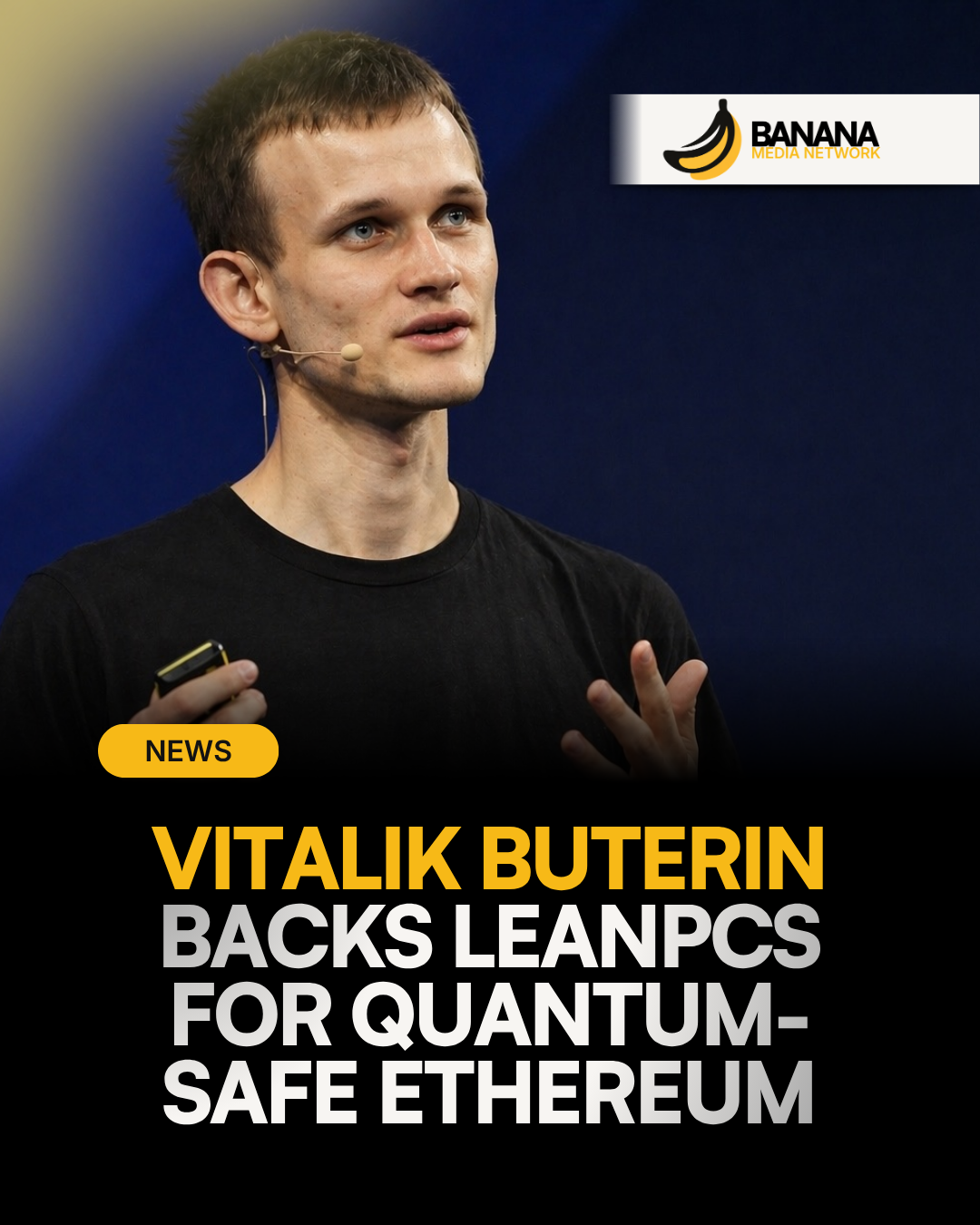
Ethereum co-founder Vitalik Buterin has thrown his support behind a lightweight cryptographic framework called leanPCS to accelerate Ethereum’s defense against future quantum computers, according to a technical post on X. As advancements in quantum hardware threaten to break the encryption protecting modern blockchain networks, the proposal offers a streamlined method to verify bulky quantum-resistant signatures off-chain while keeping main network transaction costs manageable.
Currently, Ethereum and Bitcoin rely on elliptic curve cryptography—specifically the Elliptic Curve Digital Signature Algorithm (ECDSA)—to prove wallet ownership and authorize transactions. Standard ECDSA signatures require just 65 bytes of on-chain data. However, sufficiently powerful quantum computers running Shor’s algorithm could theoretically derive private keys from public keys, exposing user funds and smart contracts to theft. Post-quantum signature schemes solve that vulnerability, but their signatures are massive, typically spanning 1,000 to 6,000 bytes. Publishing thousands of oversized signatures directly into every Ethereum block would rapidly exhaust network bandwidth and send gas fees soaring.
Over the past few weeks I've gone from thinking leanPCS is total bull to being a total bull. So let me explain some of these buzzwords in more detail.
— vitalik.eth (@VitalikButerin) November 16, 2026
At the core, 8288 is about hyper-scaling data and execution for any computation that needs to get performed on a piece of data…
Vitalik Buterin outlined the technical case for prioritizing leanPCS over more complex instruction-set architectures in a post on X. (Source: Vitalik Buterin)
What Is leanPCS and How Does It Protect Ethereum?
In plain terms, leanPCS—short for a "lean" Polynomial Commitment Scheme—acts as a cryptographic compression layer that bundles thousands of heavy post-quantum checks into a single, compact proof. Rather than forcing every user transaction to carry a multi-kilobyte signature onto the Ethereum mainnet, transactions attach a small dependency claim measuring roughly 64 to 96 bytes.
An off-chain prover then aggregates those claims using recursive STARKs—a type of transparent zero-knowledge proof that does not rely on quantum-vulnerable math—and submits one master proof to the Ethereum Virtual Machine (EVM). By validating the master proof once per block, the network confirms that every individual post-quantum signature is valid without processing the raw signature data on-chain.
Why leanPCS Beats Full Virtual Machine Overhauls on Speed
Ethereum researchers have previously explored broader frameworks such as leanSTARK, which attempts to standardize a general-purpose virtual machine architecture for recursive proofs. Buterin noted in his public technical breakdown that locking in a full instruction-set architecture early carries heavy engineering risks and prolonged consensus delays.
Instead, leanPCS isolates a narrower mathematical primitive: polynomial commitment verification. Treating this commitment check as a standardized "magic" oracle allows developers to upgrade off-chain proving systems independently while keeping on-chain verification predictable.
- Signature Footprint: Drops on-chain per-transaction overhead from 1,000–6,000 bytes down to 64–96 byte dependency claims.
- Verification Cost: Keeps estimated on-chain STARK verification around 20,000 to 40,000 gas per master proof.
- Deployment Velocity: Avoids multi-year consensus debates over rigid virtual machine instruction sets, offering faster technology integration for wallet providers and decentralized finance (DeFi) protocols.
How leanPCS Shrinks Quantum-Safe Ethereum Transactions
Contrasting current elliptic curve signatures, raw post-quantum signatures, and EIP-8288 aggregated claims to show how off-chain aggregation prevents fee spikes.
Compact footprint keeps fees low today, but remains vulnerable to future quantum computers.
Quantum-safe, but massive data payloads trigger severe network congestion and high gas fees.
Quantum-safe security achieved while preserving current Ethereum block capacity and low fees.
Institutional DeFi and Wallet Infrastructure Face Upgrade Pressure
For enterprises, custodians, and decentralized exchanges operating on Ethereum, long-term cryptographic durability is a core fiduciary requirement. Smart contracts holding billions of dollars in tokenized assets and liquidity pools depend on uninterrupted signature integrity. Without a viable quantum-migration path, legacy accounts that have already exposed their public keys on-chain remain prime targets for future "harvest now, decrypt later" attacks or sudden cryptographic breaks.
Adopting an off-chain aggregation model shifts complex proving work to specialized bundlers and Layer-2 infrastructure operators while shielding everyday users from prohibitive gas spikes. Still, relying on off-chain aggregation introduces operational dependencies: wallets, block builders, and node clients must coordinate around uniform commitment standards so transactions do not stall if an aggregator goes offline.
What Milestones Remain Before Mainnet Deployment?
Despite Buterin’s endorsement generating momentum across Ethereum’s cybersecurity and core research communities, leanPCS is not yet ready for production. While discussions around draft Ethereum Improvement Proposal EIP-8288 have framed broader post-quantum transition mechanisms, leanPCS remains an evolving technical direction rather than a finalized provision in existing draft specification text.
Core developers still need to publish formal mathematical specifications, build interoperable client reference implementations, benchmark prover latency under peak network load, and schedule a formal hard fork activation window. As Ethereum balances rapid quantum readiness against protocol simplicity, will core developers prioritize leanPCS’s narrower cryptographic shortcut over a more universal—but slower—proof standard?